Calculating horizontal stress using the stress contrast method
The Stress Contrast workflow (1D MODEL > Horizontal Stress > SC Method) allows you to derive Shmin and SHmax stresses for the rock models that exhibit contrasting rock properties in all three orthogonal directions.
Rocks with horizontal structural layering, laminations, or bedding (e.g. shale) exhibit transverse isotropy where elastic properties are similar only when they are measured in the horizontal plane and greatly differ from the properties measured in the vertical direction. Orthotropic rocks exhibit both transverse and azimuthal anisotropies due to presence of vertical fractures in flat laminated rock structures.
The horizontal stress profiles for the constitutive rock models are obtained from the stiffness tensors. For the isotropic rock model, you need two independent elastic properties to describe stiffness tensor. The transverse isotropic and orthotropic models requires five and nine elastic properties, respectively, to describe the stiffness tensor. The figure below shows the three rock constitutive models.
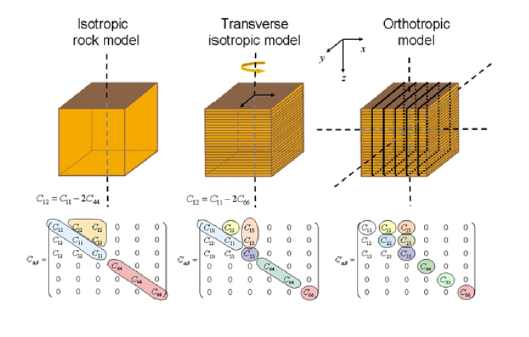
Coefficients required to calculate the stiffness tensor for the isotropic and transverse isotropic and orthotropic rock models. click to enlarge
The workflow begins with assigning the input parameters and the calculation method. You can choose from the seven available calculation methods which describes the isotropic and anisotropic rock models. For the anisotropic rock models, you can select among the three different model, such as, vertically transverse isotropy, VTI 3D and orthotropic.
For more information, see: