MohrFracs
The MOHRFRACS module in JewelSuite Geomechanics is designed to identify critically stressed faults and fractures which are more likely to be permeable and therefore more likely to control fluid flow within a reservoir. The software enables the user to easily determine the relationship between the in situ state of stress and fracture and fault geometry to identify the critically stressed faults and fractures. Input fracture and fault orientations are derived from wellbore image data, standard dip meter analysis, seismic interpretation, or other methods. An independent set of stress magnitudes and orientations, are also required as input. The program provides concise graphical outputs to differentiate critically stressed fracture planes from stable planes.
Using the results of MohrFracs aids the user in the following:
- Identifying the subset of critically stressed (and more likely permeable) faults in a general population.
- Selecting drilling trajectories that optimize reservoir drainage.
- Evaluating the effects of production-related changes in reservoir pressure on fracture permeability and fault seal integrity.
- Evaluating the likelihood of induced slip on faults that might compromise casing integrity or lead to excessive losses.
- Improving hydrofracturing efficiency and secondary recovery efforts by providing information to optimize well placement and/or selecting zones for recompletion.
The MohrFracs module concept
Knowledge of the relationship between natural fracture systems and tectonic stresses has direct application to problems of reservoir performance, hydrocarbon migration and entrapment, and wellbore stability. Acoustic, electrical, and optical wellbore images provide the means to detect and characterize natural fracture systems and distinguish these from drilling induced wellbore failures. MohrFracs module implements a new technique to apply knowledge of natural fracture systems and the in situ state of stress to assess reservoir permeability, evaluate fault seal, and avoid wellbore instability associated with active faults.
Reservoir Permeability and Fault Seal Integrity
It is well known that natural fractures and faults provide the primary pathways for fluid flow through fractured reservoirs. However, not all faults and fractures are permeable. Permeability can be maintained on a fault or fracture surface by displacement which prevents chemical or mechanical sealing and can result in permeable pathways likely to control fluid flow in fractured reservoirs. Fractures and faults that are not critically stressed are generally impermeable. Therefore, determining the proximity of a fault or fracture to failure (critically stressed) helps to identify the population of potentially permeable fractures. With knowledge of the stress state and fracture plane orientations it is possible to predict which fractures are likely to be the most permeable (Figure MF1; see Barton, Zoback and Moos, 1995).
MohrFracs module makes predictions using the Mohr-Coulomb failure criterion. This is a linear relationship between the shear stress and the effective normal stress acting on a fracture or fault plane. The gradient of the shear failure envelope (Figure MF1) is defined by the coefficient of sliding friction (μ). MohrFracs moudle assumes a default coefficient of friction (μ) of 0.6, however, the user has the option to change this value. Further explanation can be found in Input Definition and Slip Analysis.
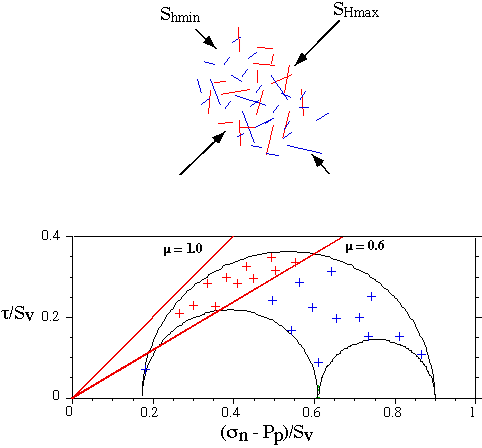
Figure MF1. In a set of randomly oriented, pre-existing fractures (blue and red lines, top figure), only the critically stressed fractures (shown in red) are permeable. The calculated ratio of shear stress to normal stress for each plane is plotted on the lower figure (a Mohr diagram). The critically stressed fractures (red) and non-critically stressed fractures (blue) are shown as '+' symbols on a Mohr diagram in the bottom figure. click to enlarge
MohrFracs module applies this predictable relationship between in situ stress and permeability in its analysis, aiding the engineer and geologist in a variety of applications:
- Optimize production from fractured and faulted hydrocarbon and geothermal reservoirs.
- Assess fault seal integrity and reservoir compartmentalization.
- Identify locations and depths where excessive fluid losses into permeable faults might present a drilling problem.
- Locate and engineer production and injection wells to account for spatial variations in permeability and permeability anisotropy.
- Design enhanced recovery and drilling strategies.
- Determine the effect of production or injection on fault seal, reservoir compartmentalization, and risk of slip on faults that may affect the integrity of wellbores and production facilities.
- Determine the effect of production or injection on fault seal, reservoir compartmentalization, and risk of slip on faults that may affect the integrity of wellbores and production facilities.
- Identify and predict the permeable fracture systems along which contaminants or groundwater can flow for site characterization studies.
Wellbore Stability
Stress orientations and magnitudes also control wellbore stability during both drilling and production. Optimizing wellbore stability and minimizing failure during drilling and production, including casing collapse due to localized fault slip, requires understanding the stress state and identifying critically stressed fractures. Slip on fractures can be avoided and stress-controlled wellbore instabilities can be minimized by the selection of optimal wellbore trajectories and through careful production design to minimize the risk of inducing slip on the intersecting faults. Likewise knowledge of the pressures to induce critically stressed fractures can provide upper limits on mud weights to prevent losses while drilling.