Horizons in a 3D grid and 3D mesh
Right-click on an horizon inside a 3D grid or 3D mesh in the JewelExplorer to perform various actions:
Hide (Only for context menu in a view) Hide it in your view.
Show Legend Show or hide a legend for it in your 3D View.
Display Settings
Color Pick a color to display it in the view.
Mesh Color Pick the color to be used to display the mesh.
Node Color (3D mesh only) Pick the color to be used to display the nodes.
Render Mode Display it as a solid surface, as a wireframe, or as a solid surface with wireframe mesh. For a surface in a 3D mesh model, you can also select to display as a solid surface with wireframe mesh and nodes, as a solid surface with nodes, as a wireframe, as a wireframe with nodes or as nodes only.
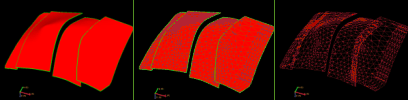
Render modes. Left to right; solid, solid with wireframe mesh, and wireframe mesh only. click to enlarge
Render Side (3D mesh only) Display it with tetrahedrons on either side 1 (above), side 2 (below) or both sides of the surface.
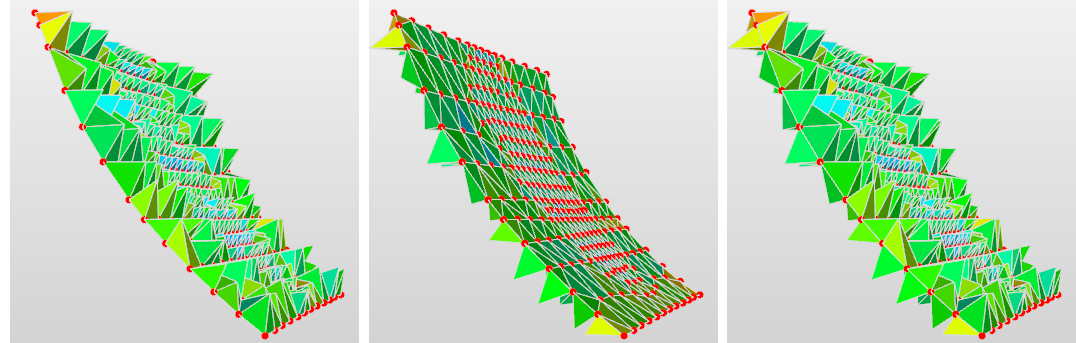
Render side. Left to right; side 1, side 2, side 1 and 2 simultaneously. click to enlarge
Reset Boundaries Reset the boundaries of the horizon.
Transparency Make it semi-transparent. Adjust the opacity value from the Property Inspector.
Lighting Turn a lighting effect on or off. The lighting effect can enhance the visibility of contours.
Contours Show or hide contour lines.
Contour Labels Show labels on contour lines.
Contouring Options Open the Contouring Options form to specify a wide range of contouring settings.
Interpolation This display setting affects the (color) interpolation of the object displayed in your view. Without interpolation, the color boundaries are sharp; with interpolation switched on, the boundaries are smoothed.
Create
Create Point Set (Only for 3D Mesh) Create two point sets from the surface, one for each side of the surface. Useful to QC properties at either side of the surface, e.g. discontinuous pore pressure across a fault. In the 'Select Properties' dialog that opens, select the properties that you want to have available on the point set. Only nodal properties are available for selection. The point set will be placed in the Data folder.
Create Tri-mesh Create a tri-mesh from the surface. For surfaces in a 3D mesh, two tri-meshes will be created, one for each side of the surface (useful to QC properties at either side of the surface). Select the properties that you want to have available on the two tri-meshes from the 'Select Properties' dialog. The tri-mesh(es) will be placed in the Data folder.
Create Node Side Property From Surface (Only for horizons in 3D Mesh) Create a property with property classes indicative for the side of the horizon where the nodes are located (side 1, side 2 or shared). Nodes are shared, unless you have used the 'Allow discontinuous properties' (to split compartment boundaries) or 'Split along selected surfaces' (to split surfaces) option on the MODEL > 3D Mesh > Mesh Options form. Use the Object Inspector  to display the classes.
Create Element Side Property From Surface (Only for horizons in 3D Mesh) Create a property with property classes indicative for the side of the horizon where the elements are located (side 1 or side 2). Use the Object Inspector to display the classes.
Properties
Set Active Property Select a property for display in the 3D View. You can also select properties to view using the visibility checkboxes in the JewelExplorer.
Default Geometry Properties Opens a predefined list with properties. When you select a property, the values for this property are calculated, the property is added to the JewelExplorer and displayed in the active view. If you update the geometry of the object, the property is automatically recalculated. For tri-meshes and 3D meshes, you can choose from multiple mesh quality properties to help you assess the quality of the mesh.
The next context menu options are only for horizons in a 3D grid:
View History Open the Audit Trail to view a history of changes, including user name, date, context, workflow process, workflow panel, and description. For more on the Audit Trail, see Using the audit trail.
Export
To ascii Export the horizon in a ASCII file format.
Remove
Delete Delete the object from the solution. Depending on the type of object, geometric representations, subfolders or objects it may contain are deleted as well.