Failure criteria
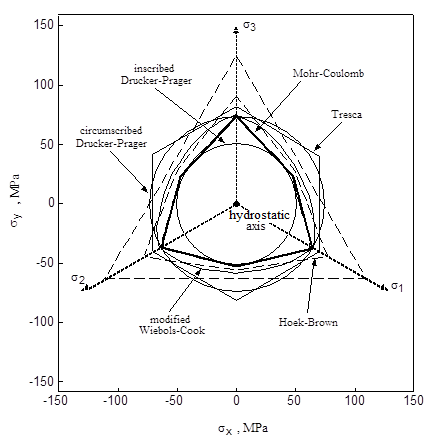
Failure criteria used in JewelSuite Geomechanics click to enlarge
JewelSuite Geomechanics offers the following elastic-brittle failure criteria that are based on effective stresses, which are defined throughout the entire application (except for the poroelasticity models) as total stress minus the product of Biot’s coefficient and pore pressure.
si = Si – Biot ´ Pp
The Mohr-Coulomb yield surface (envelope) in the space of effective principal stresses s1, s2, s3 is a right hexagonal pyramid with its axis along the hydrostatic axis s1 = s2 = s3. It is convenient to present yield surfaces in an auxiliary plane perpendicular to the hydrostatic axis (octahedral plane) because all points in the plane represent deviatoric stress states. The diagram shows envelopes for six failure criteria in the octahedral plane (sx, sy) which intersects the principal stress axes at s1 = s2 = s3 = 50 MPa (dashed triangle). Failure envelopes for these six criteria are fully defined by the coefficient of internal friction m and the uniaxial rock strength C0 (m = 0.6 and C0 = 50 MPa are used in the diagram):
Mohr-Coulomb criterion (Jaeger and Cook, 1979)

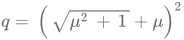
Tresca criterion (Jaeger and Cook, 1979)

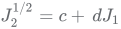
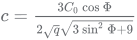
Circumscribed Drucker-Prager criterion (Zhou, 1994)





Inscribed Drucker-Prager criterion (Veeken et al., 1989)
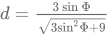

Modified Lade criterion (Ewy, 1998)
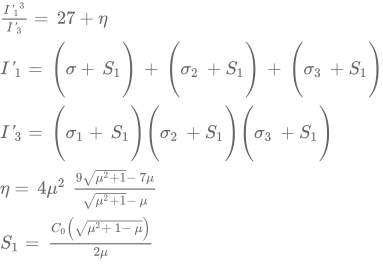
Hoek-Brown criterion (Hoek and Brown, 1980)

This Criterion, is a function of two empirical constants, m and s, which depend on the properties of the rock and on the extent to which it was broken before being subjected to the failure (values for intact sandstone, s = 1 and m = 14.3).
Stassi-D’Alia criterion (Jaeger and Cook, 1979)

is dependent on the uniaxial rock strength C0 and the tensile strength T0 instead of the internal friction coefficient μ.