Using the coefficient of asymmetry to differentiate breakouts from keyseats
Because of the independent motion of each of the arms in the six-arm tool, it is possible to separate symmetrical and asymmetrical elongations (breakouts and keyseats) by using the coefficient of asymmetry (Ac). This coefficient is based on a rule of plane geometry, that states that perpendicular bisectors of chords of a circle intersect in the center of the circle. If the borehole cross section is not circular (see image below), the bisectors of chords S1, S2, and S3 do not intersect in one point but form a triangle, which is a measure of borehole asymmetry.
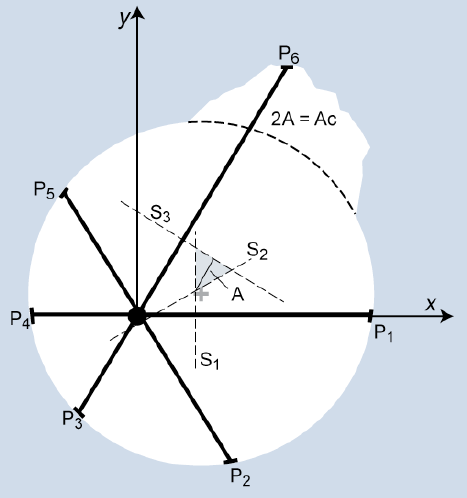
Schematic image showing an off-centered 6 arm dipmeter. The triangle is created by the perpendicular bisectors (S1, S2 and S3) of the uncorrected calipers. click to enlarge
Jarosinski and Zoback (1998) derived that twice the height of this triangle is equal to the coefficient of asymmetry, defined as:

Where P1, P2, P3, P4, P5 and P6 are raw pad lengths before correction, see image. For the purpose of data filtering, the coefficient of asymmetry is normalized by the difference between the maximum and minimum calipers and is given as a percentage of the total elongation:

When the normalized coefficient of asymmetry, ACN, is high, the wellbore cross section is always asymmetrical. In the opposite case however, when ACN is close to 0, the well is not necessarily symmetrical. This may happen when two calipers get stuck in a keyseat, which is indicated by a negative value of Sc (seeSix-arm caliper analysis, image H). Results of filtering data at depths where negative values of coefficient of shape coexist with low values of coefficient of asymmetry should be treated carefully and should be independently checked by looking at the pad positions in borehole cross section.