Using the shape coefficient to measure borehole elongations and determine breakout direction
In the case of a four-arm dipmeter, the direction of the longer caliper (Cmax) is taken as the direction of borehole elongation (see image below, F and I). For the six-arm tool, however, two calipers may be within one enlargement, and the direction of the longest caliper does not necessarily coincide with the direction of borehole elongation (see image below, E and H). In this case, the real breakout direction is somewhere between the longest and the intermediate corrected calipers (Cmax and Cint).
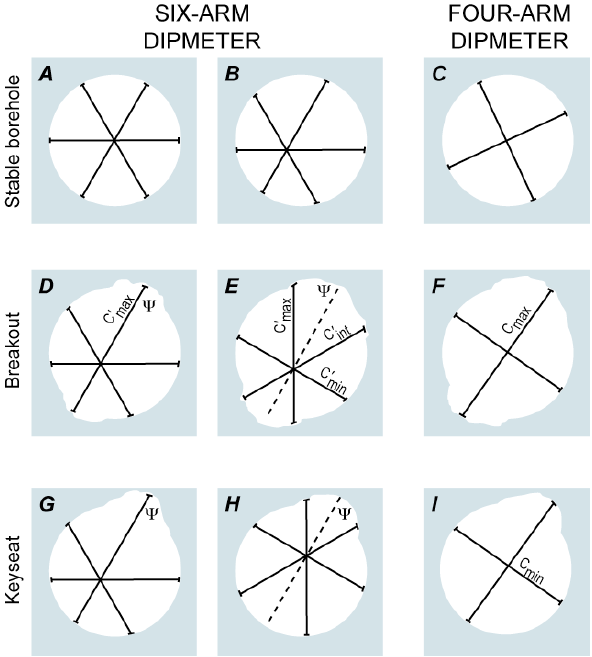
Schematic image of a 6 arms and 4 arms caliper tool and interpretations of the borehole geometry (after Jarosinski and Zoback, 1998; Jarosinski 1998). The borehole elongation direction is denoted by the dashed line, labeled ψ. Note that the caliper measures shown in the six-arm examples are different from the corrected caliper lengths. click to enlarge
The shape coefficient (SC) allows you to minimize these errors by evaluating the relative position of the calipers versus the shape of the borehole cross section. It is defined as:

|
If SC > 0, Cmax-Cint must be greater than Cint-Cmin, implying that one caliper falls into the enlargement, see image below. The azimuth of Cmax is taken as the direction of the borehole elongation.
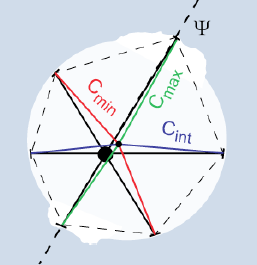
Schematic image showing Cmax-Cint is greater than Cint-Cmin. In this case, the shape coefficient is also greater than 0. click to enlarge
If SC < 0, Cmax-Cint must be smaller than Cint-Cmin, implying that two calipers fall into the enlargement, see image below. The direction of the borehole elongation is assumed to be perpendicular to the azimuth of Cmin.
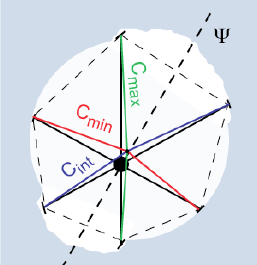
Schematic image showing Cmax-Cint is smaller than Cint-Cmin. In this case, the shape coefficient is also smaller than 0. click to enlarge
The shape coefficient helps both in determining breakout direction, and also as a measure of borehole elongations in data filtering. Calculated values of SC that do not exceed a pre-defined limit may indicate shallow elongations or noisy data.
References:
Jarosinski, M., and M. D. Zoback, 1998. Comparison of six-arm caliper and borehole televiewer data for detection of stress induced wellbore breakouts: application to six wells in the Polish Carpathians, pp. F8-1–F8-23 + 12 figures.
Jarosinski, M., 1998. Contemporary stress field distortion in the Polish part of the Western Outer Carpathians and their basement, Tectonophysics v. 297, p. 91-119, 1998.