Horizontal stress methods
Effective Stress Ratio method
In the Horizontal Stress Modeling workflow (1D Model > Horizontal Stress > Horizontal Stress) you can calculate the maximum and minimum horizontal stress from overburden stress, pore pressure and Shmin and Shmax effective stress calibration points. If you have entered information about the stress in the well, such as LOT/FIT points, RFTs, or lost circulation events, you can plot them in the tracks of the horizontal stress model as unitless effective-stress-ratio points. You can then calculate the horizontal stress from these calibrations points when interpolated with a custom trend line.
The equations that define this method are:


Stress Contrast method
The general equations used in the Stress Contrast method, for both the isotropic and anisotropic rock models, to derive Shmin and SHmax stresses from existing logs and rock mechanical properties:


No Tectonic Strain
Also known as Eaton equation, this equation is based on bilateral constraint:

Isotropic Tectonic Strain

Consider the Biot coefficient equal to 1. The first term of the equation represents the horizontal stress for a relaxed, homogenous, laterally extended half space (uniaxial strain) after applying an infinite load instantaneously. The last term of the equation correspond to the tectonic strain. This equation is also known as the evolution of Eaton equation.
Equations used for calculating the stiffness tensor coefficients and Thomsen coefficients
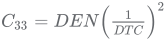
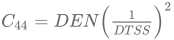
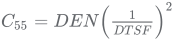
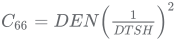
Linear elasticity condition

Thomsen Epsilon coefficient

Thomsen Gamma coefficient

Thomsen Delta coefficient
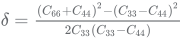
Terms for horizontal stress profile
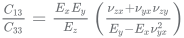
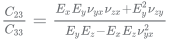
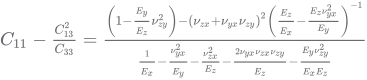


The non-diagonal terms of the stiffness tensor can be derived from compressional wave velocities propagating at 45-degree oblique angles from the three principal stress directions (x, y, z).



SHmax Equilibrium Ratio method
The SHmax Equilibrium Ratio method allows you to set the Shmax based on one of the three stress states defined by frictional faulting theory (normal faulting, strike-slip faulting, and reverse faulting). A normal faulting stress regime requires that SHmax is the intermediate principal stress magnitude, Shmin is the least principal stress, and Sv is the maximum principal stress. Strike-slip faulting and reverse faulting regimes require that SHmax is the maximum principal stress magnitude. For strike-slip, Shmin is the least principal stress and Sv is the intermediate principal stress; for reverse, Sv is the least principal stress and Shmin is the intermediate principal stress.