Pore pressure prediction methods
Increase in vertical stress during loading can lead to incomplete dewatering of the sediment when part of the weight of the load is added to the pore fluid pressure. The mechanism is referred to as “disequilibrium compaction” and is manifested in the bulk rock by excess pore pressure and a higher porosity relative to the normally pressured and fully compacted rock at the same depth. The overpressure starts at a depth where the permeability becomes to low to allow complete dewatering. The next methods enable you to calculate the pore pressure when undercompaction is the mechanism involved.
Eaton
You can apply the Eaton method to the following observed data (xobs):
- shale density
- acoustic log
- resistivity log
- density log
The relationship between the observed parameter/normal parameter ratio and the formation pressure depends on changes in the overburden gradient.
The formulas for calculating Pp are as follows:
For non-acoustic logs:

For acoustic logs:

Ratio pore pressure method
The Ratio method can be applied to the following data (xobs):
- acoustic log
- resistivity log
- density log
The formulas for calculating Pp are as follows:
For non-acoustic logs:

For acoustic logs:

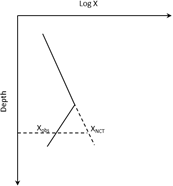
where xNCT is the value of the data on the NCT, and xobs is the observed value of the data from the relevant log.
click to enlarge
The difference between observed values for the compaction parameter and the normal parameter extrapolated to the same depth is proportional to the increase in pressure.
The ratio method is easy and widely used. However, because it is empirical, the results are not always satisfactory. Adjusting the calculations based on measurement (RFT, test) can improve the results by introducing a correction coefficient (c) in the Equivalent Depth method.
Equivalent Depth
The Equivalent Depth method can be applied to the following observed data (xobs):
- d exponent
- shale density
- acoustic log
- resistivity log
- density log
- seismic interval velocities
- any direct or indirect measurement of clay porosity
click to enlarge
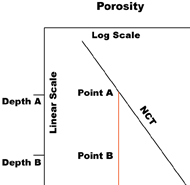
The equivalent depth principle states that any point vertically below a point on the NCT (plotted on a log/linear scale) must have the same degree of compaction. As the logged datum (for example, porosity) is the same for any point on the vertical line, any increase in overburden pressure with depth must be borne by the pore fluid.
Bowers
The Bowers Method, developed by Glenn L. Bowers in 1995, is an effective stress method for calculating pore pressure which not only accounts for undercompaction as the overpressure mechanism but also for fluid expansion using acoustic or velocity log data. Fluid expansion mechanisms can include clay dehydration, hydrocarbon maturation, smectite-ilite transformation, mineral precipitation/cementation reactions, charging from other zones, and aquathermal pressuring.
Knowing that the virgin curve could be represented by:

Where Vo is the initial velocity. For offshore wells this value could be set as 5000 ft/sec which is the velocity of water.
Values for A and B parameters provided by Bowers are shown in the table1. However, you need to calibrate to have a proper parameter for a specific area.
| Location | A | B | Velocity units | Stress units |
| U.S Gulf Coast | 4.4567 | 0.8168 | Kft/sec | kpsi |
| U.S Gulf Coast (water depths between 600ft and 1500 ft) | 28.37 | 0.6207 | Kft/sec | kpsi |
| Central North Sea. Tertiary shales (above 9000 ft) | 2.8746 | 0.9037 | Kft/sec | kpsi |
|
Central North Sea. Chalk |
802.1 | 0.3215 | Kft/sec | kpsi |
| Central North Sea | 8.116 | 0.8002 | Kft/sec | kpsi |
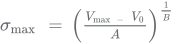
The unloading curve is defined by the empirical relation:

 represents the maximum effective stress when V, is Vmax, which means, the velocity before reversal starts. Additionally, Bowers define a third empirical parameter, U as a measurement of the sediment plasticity. As a default value, U is set 1 (perfectly elastic). For the Gulf of Mexico, for instance Bowers recommended a value of U that lays between 3 and 8.