Creating well target zones
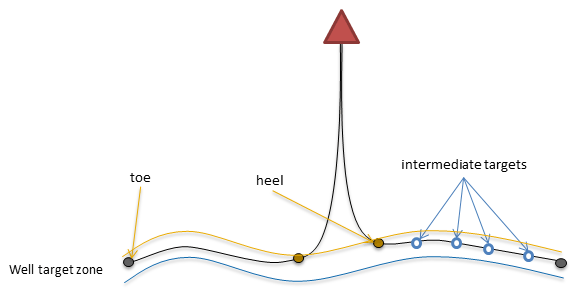
Horizontal well showing design components click to enlarge
You can create target zones for wells you are planning. A target zone is a depth interval between two horizons to which the horizontal part of a well should be confined. You then assign your target zones to your well plan.
When you create a target zone, you can specify one or more zones of interest. Each includes the position of the heel and the toe of the wells in the zone, the number of intermediate targets (positions along the wellbore between heel and toe that define the shape of the well trajectory in the target zone) and the depth position of the intermediate targets with respect to the heel and toe of the well. If you create a well pad using a Target Zone, the wells of the well pad will be positioned according to the target zone settings.
To create a target zone
Open the Target Zone form (plan > Wells > Target Zone for single well plans or plan > Well Pads > Target Zone for well pads).
From the Target zone drop-down list, select Create new to create a new target zone, or select an existing target zone to edit its settings.
Select a model form the Source drop-down list. This will automatically populate the Top horizon and Base horizon drop-down lists with all possible surfaces. The two horizons you select must come from the same model, and have either a 2D grid or tri-mesh representation.
On the bottom part of the Target Zone form, you specify well target positions in the zone you defined. You do this by setting the depth position of the well targets (heel and toe) that guide the well trajectory in the target zone and the number of intermediate targets. Intermediate targets are located between heel and toe. Specify how many targets you require in the Intermediate targets field. A few intermediate targets (three intermediate targets per 2000 m) is sufficient for a continuous horizontal section, but you may need more where the geological situation requires, when a well needs to remain in a specific layer which is offset at a fault, for example.
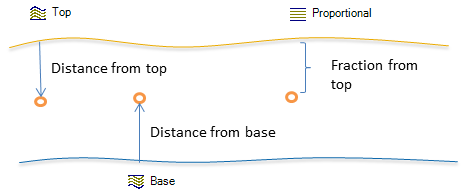
Heel and toe positions click to enlarge
Specify how the positions of the heel and the toe of the well are defined with respect to the top or bottom surface of the target zone using the Conform type drop-down list. Select Top or Base to define the position relative to the top or bottom surface, or Proportional to specify heel fraction and toe fraction.
Select either Use target locations or Use inclination objective to specify the depth positions of heel and toe. If you select Use target locations, simply enter the heel and toe distances in the Heel distance and Toe distance fields if the Conform type is Top or Base, or enter values for Heel fraction and Toe fraction as fractions of the distance between top and base of the target zone if the conform type is Proportional.
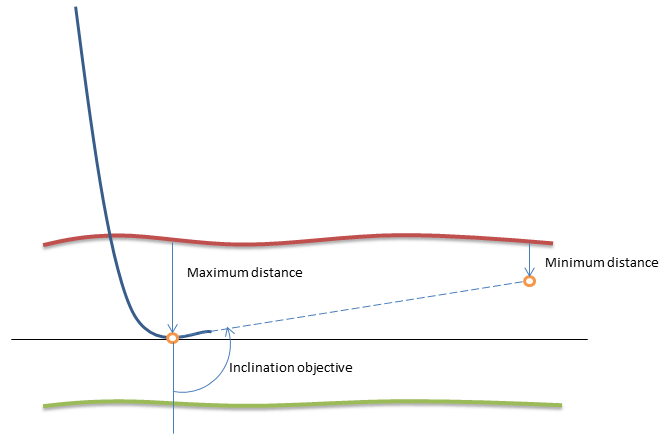
Use inclination objective method click to enlarge
If you select Use inclination objective, a well path is created between Heel and Toe that runs at a specified angle (Inclination) to the vertical. In certain circumstances, this may be needed to optimize flow from the toe end of the well. The well path can be constrained between a Minimum distance and a Maximum distance from the top or bottom of the zone or, if the Conform type is Proportional, within a relative thickness range of the target zone (Minimum fractionand Maximum fraction). The inclination is the angle of the well path with the vertical. An inclination of greater than 90° creates a well trajectory in which the toe lies closer to the top of the target zone than the heel.