Flat triangles
Triangles that have extreme aspect ratios are numerically instable as their orientation cannot be determined accurately. Processing tri-meshes that contain such triangles may show artifacts. The triangles of the 3D mesh structural model are steering the meshing algorithms. Flat triangles may therefore lead to very elongated mesh elements. Such elongated tetrahedrons are numerically unstable. This may lead to a rejection by the simulator or to numerically inaccurate results.
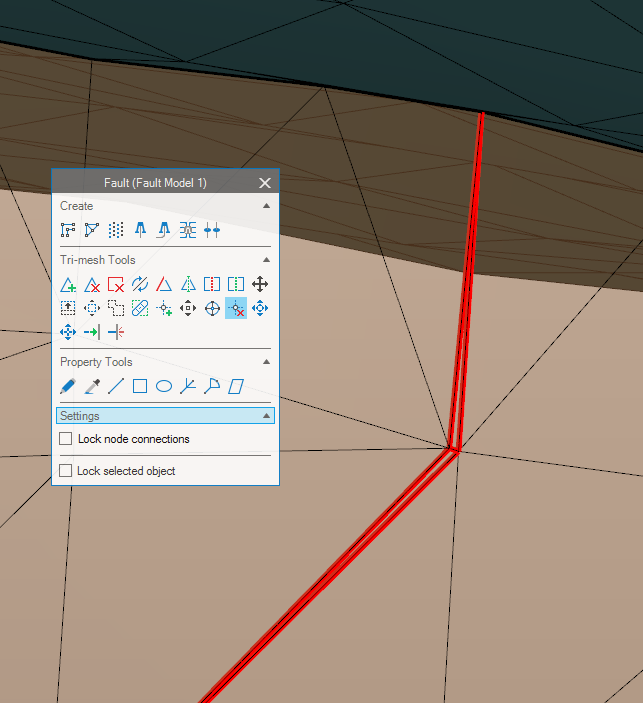
Flat triangles introduced close the edge of a fault due to the surface resampling. In this scenario you can use the Remove Node tool to resolve the issue. click to enlarge
The flat triangles may be introduced because of different reasons. The most common among them is related to resampling and triangulation of input data for which you may need to revisit your input data to trace back the origin of flat triangles. Another cause is the re-association of tri-meshes at their intersection in which a watertight and associated relationship of the nodes is reestablished. Flat triangles are therefore more likely to occur at your tri-mesh boundaries.
Solving the issue using the (editing) tools
Flat triangles can be treated with different tools. An automated tool Collapse Flat Triangles can be run which is stored underneath the QC tools. For a manual assessment, use the Remove Node ( ) tool from the editing palette and click on the node.