About building a fluid model
The integration of data from different disciplines into one fluid distribution model enhances consistency, efficiency and accuracy in volumetric estimation.
Reducing uncertainty
The fluid distribution can be very complex, especially for structurally complex fields, and often carries a large uncertainty. This uncertainty has a major impact on the volumetric estimation. The Fluid Modeling workflow helps you to combine all the available data into a consistent description of the initial fluid distribution. For example, the sealing behavior of faults can hardly ever be established with high confidence. The initial ideas regarding the importance of faults need to be integrated or revisited using the well log data received from the petrophysicist. Using the Well View, you can display the logs for wells penetrating the same compartment. This will give you an overview of the uncertainty involved in the fluid levels estimation and is an essential QC step.
Ensuring consistency across disciplines
JewelSuite Subsurface Modeling does not require a 3D grid for defining fluid distribution. The Fluid Modeling workflow allows you to work directly with the surfaces from your structural model. Once you create compartments and define your fluid model, you have the flexibility to map the fluid model properties to multiple 3D grids. This provides consistency between volumetric calculations of a static and a dynamic model.
In the modeling process, fluid contacts seen in well logs (i.e. GOC, OWC) are clearly distinguished from compartment fluid levels (i.e. GOC, FWL). Also the fluid-up-to and fluid-down-to (e.g. gas-up-to, oil-down-to etc.) levels, obtained from fluid logs, provide supportive information.
Warnings and error messages can be seen on the Fluid Levels form if there are any inconsistencies between fluid logs of individual wells and the fluid levels assigned to compartments.
To define the fluid distribution within compartments, JewelSuite uses the free water level (FWL), which is the intersection of hydrocarbon and water pressure gradient lines. A variation between the oil water contact (OWC) observed in fluid logs and the FWL may exist depending on the reservoir quality. Even though the intersection of gas and oil pressure gradient lines is the free oil level (FOL), JewelSuite uses the gas oil contact (GOC) within a compartment for the purpose of simplicity. The variation between the FOL and GOC is insignificant due to the higher density difference between gas and liquid.
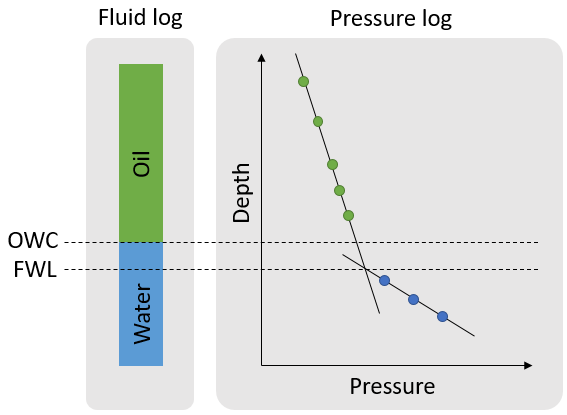
Oil water contact (OWC) is obtained from fluid logs, whereas the free water level (FWL) is obtained from the intersection of pressure gradient lines. A variation between the two may exist depending on the reservoir quality. click to enlarge