Definitions in fault and fracture stability
|
Azimuth Shear |
Azimuth of shear stress component. |
|
Azimuth SHmax |
Azimuth of maximum horizontal stress. |
|
CFF |
Coulomb Failure Function (or CF Criterion of CF Stress). Absolute difference between actual observed shear stress and critical shear stress. With CFF << 0 a fault is considered stable. |
|
Critical Cohesion |
The fault cohesion under which the fault would become critically stressed. |
|
Critical FCoefficient |
The fault friction coefficient under which the fault would become critically stressed. |
|
Critical Injection pressure |
The difference between the absolute critical pore pressure and the pore pressure. |
|
Critical pore Pressure |
The critical pore pressure is the pore pressure under which the fault triangle would become critically stressed. |
|
Dip azimuth |
Azimuth of fault dip direction. |
|
Dip Shear |
Dip direction of shear stress component. |
|
Fault Cohesion |
Measure for the ‘internal strength’ by which a fault is bound together. |
|
Fault Friction Coefficient |
The Fault Friction Coefficient is a dimensionless scalar value which describes the ratio of the force of friction between the two ‘sides’ of the fault and the force pressing them together. The coefficient of friction depends on the materials involved, weak materials have a low friction coefficient. |
|
Maximum Horizontal Stress |
Maximum value of the horizontal stress. |
|
Minimum Horizontal Stress |
Minimum value of the horizontal stress. |
|
Overburden Stress |
Vertical stress due to overburden load. |
|
Pore Pressure |
Pressure of the pore fluid. |
|
Shear Fault |
Shear stress acting on the fault. |
|
Smoothness |
Degree of smoothness expressed as the angle between neighboring triangles of the tri-mesh. |
|
Sn Fault |
Normal stress acting on the fault. |
|
Tau ratio |
Ratio between actual observed shear stress and critical shear stress. A value of 1 corresponds to the critical state, i.e. fault slip might occur. Values smaller than 1 are non-critical. |
Tau ratio and Coulomb failure criterion
One measure for the fault leakage potential or the fault stability is calculating a relative property related to the shear stresses. For Tau ratio, the observed shear stress τ is divided by the critical shear stress τmax. With τratio<<1 the fault is considered stable. With τratio≈1 the critical state is reached (see image below). This measure is commonly used to see the critical state potential of a fault surface as a whole. Next to a relative expression of the shear stress impact, an absolute measure is also possible: With the Coulomb failure criterion (CFF), the absolute difference is calculated. Here CFF is CFF=τ-τmax. For CFF<0 no critical state behavior is expected. For values close to 0, the shear stress approaches critical values.
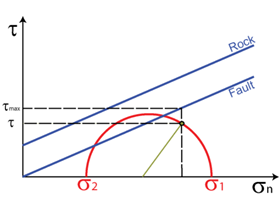
Tau ratio describes the fault leakage potential by taking the ratio between the observed or calculated shear stress τ and the critical shear stress τmax. The absolute difference between τ and τmax is used for the Coulomb failure criterion (CFF). click to enlarge
Critical state expressed by pore pressure
Rather than comparing the critical shear stress with the actual shear stress as seen in the previous example, the critical pore pressure can be calculated as well (see image below). For a given shear stress on the fault, the effective normal stress is calculated that would correspond to a critical state. This effective critical normal stress is compared with the observed normal stress. This allows deriving the critical pore pressure as an absolute value or a relative value. The difference between the absolute critical pore pressure and existing pore pressure is called the critical injection pressure. These two properties are practical for assessing the critical state potential for changes in pore pressure due to drilling operations or reservoir development.
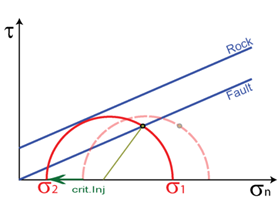
The fault leakage potential here is expressed by pressure. The pressure is calculated in which the stress state of the fault would reach the critical state. In Mohr space this is equivalent of moving the Mohr circle along the normal stress axis. The critical absolute pore pressure can be calculated as well as the difference between the actual and the critical pore pressure. click to enlarge