Using implicit depth uncertainty realizations in dynamic simulation
In JewelSuite Subsurface Modeling you can carry implicit depth shifts (applied via the Depth and Thickness Uncertainty Workflow) forward to dynamic simulation by using the 'Re-run and Save Single Realization' option on the Results Summary form of the study strip (see Re-running and saving a single realization). Before you can use implicit depth shifts in dynamic simulation you must have run a volumetrics study with the study strip that incorporated depth and thickness uncertainty. You can then use the 'saved realization' as input to reservoir simulation, where the simulation case will use the updated geometric properties and transmissibility values as input.
- If you are using a study which was run in a JewelSuite version 2021.1 or older, your simulation cases are not kept in the saved realization (they are removed). To avoid this issue, run your study again in JewelSuite version 2021.2 or newer.
- The 'saved realization' will contain the simulation cases that were present in your solution during the study run. Any simulation case that was added later is not kept in the saved realization.
How to incorporate an implicit depth shifted realization in your simulation case
- Follow step 1 to 4 of section Re-running and saving a single realization to generate a 'saved realization' (i.e. a solution file for the realization of your choice).
- Open the 'saved realization'. In the JewelExplorer, a new folder exists under the 3D grid called Depth and Thickness Uncertainty (see image below), containing the updated depth shift properties (i.e. Base Shift, Top Shift, Cell Center Depth, Cell Volume and Vertical Cell Thickness). To incorporate implicit depth in your simulation case it is important that this folder exists (do not delete it). The Base Shift and Top Shift properties will be used for calculating properties needed for the simulation case.
- Click one of the following buttons of the simulate strip, which will update the properties under your simulation case folder (3D Grid > Properties > your simulation case):
- Faults and NNCs form > Connect faults button
- Build Deck button
- If you have a schematic grid you need to build it one more time to update its properties (click the Create schematic grid button on the simulate > Reservoir Description form).
You can now run the reservoir simulation with the implicit shift incorporated in the simulation run.
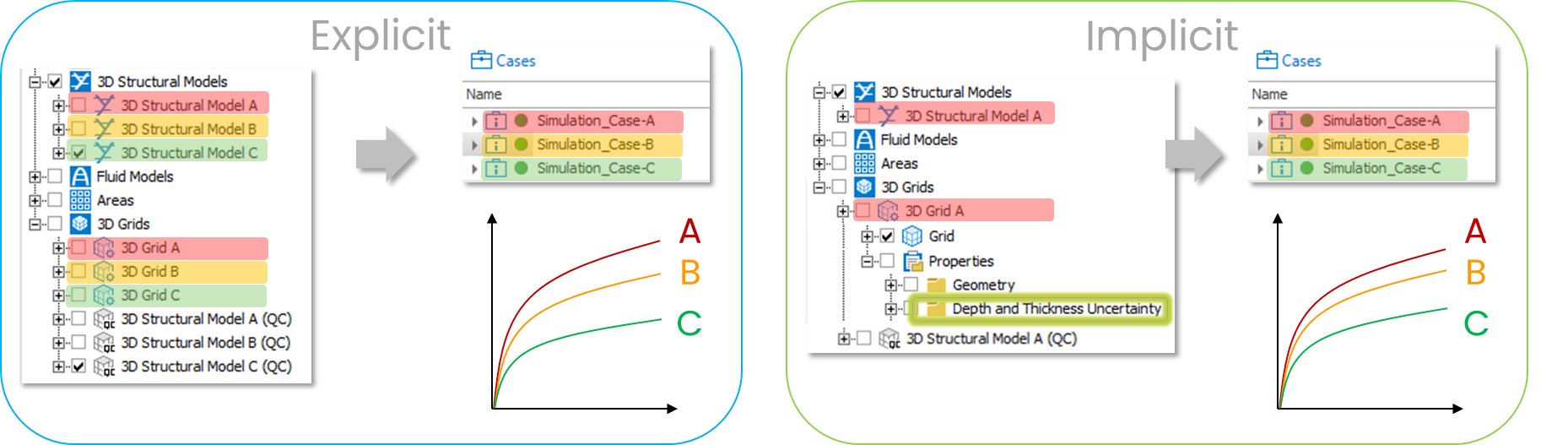
Multiple dynamic simulations are normally run on multiple explicit input models (left image). With implicit depth and thickness uncertainty, you can run many simulations on the same 3D grid, given that you save the realizations of your choice with the 'Re-run and save realization' option on Results Summary form. In the 'saved realization', the required shift properties for the dynamic simulation are stored under the 'Depth and Thickness Uncertainty' folder in the JewelExplorer (right image). click to enlarge
Using dynamic simulation to reduce structural model uncertainty at an earlier stage
Reservoir simulation can often give valuable insight into static model uncertainties. As uncertainty around the structural model is often one of the biggest uncertainties in static modeling, it can be of great value to reduce this uncertainty at an earlier stage, instead of carrying the full range (of uncertainty) to the final dynamic simulation. When early feedback from dynamic simulation can narrow down structural model uncertainty or even lead to updates of the structural model (or adding of another concept to the Subsurface Model), there are some main advantages:
- You can run many simulation cases on the same 3D grid, as the depth and thickness uncertainty will modify the 3D grid properties implicitly.
- Reduced structural model uncertainty leads to more accurate history matching at a later stage.