The building sequence of surfaces in the 3D structural model
The order in which surfaces of the 3D structural model are constructed is fully determined by the corresponding events in the (assigned) stratigraphic model. The sequential order in which surfaces are constructed is as follows:
Geometric Representation > Stratigraphic Level > User Priority > Layering Type
Stratigraphic level Within a group of dense (or sparse) data, the stratigraphic level determines the order of construction. First Level 1, then Level 2 etc.
User Priority When surfaces have the same geometric representation and are present at the same level, you can use the User Priority to set a construction order. In the example shown below, the User Priority is not used.
Layering Type Within a stratigraphic level, the layering type will determine the order of construction: top to base, or base to top.
Explaining the building sequence
The Stratigraphic Model is assigned to the structural model on the 3D Structure > Assign Data form. On this form, all geometric representations of an event are listed. In the Stratigraphic View and the 3D Structure Zonation View, a letter S and/or M are added to the event name. In the Stratigraphic View, these are indicating whether the event is represented by a surface data [S] (i.e. a tri-mesh, 2D grid, polyline set or point set) and/or a marker [M]. In the 3D Structure Zonation View, these indicate what was actually assigned to the structural model. The geometric representation determines in the first place which surfaces will be constructed first.
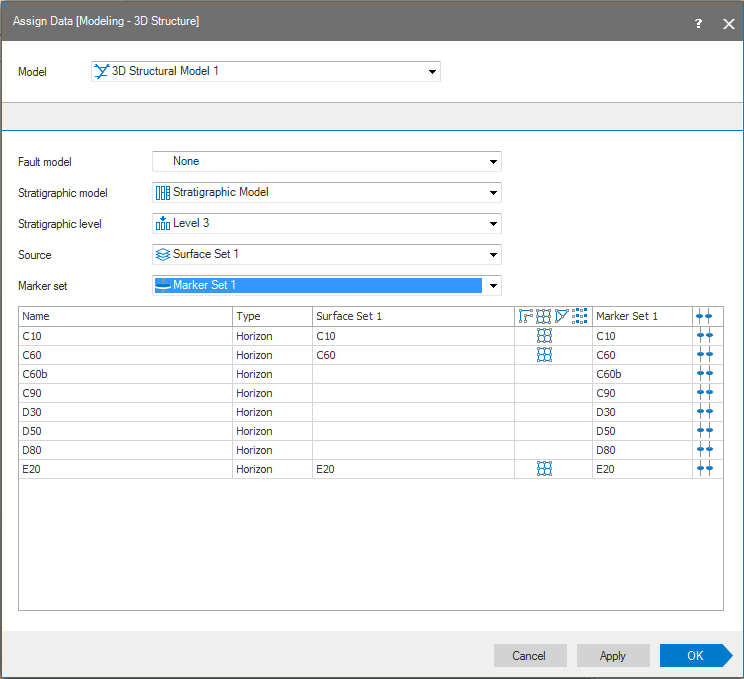
Event names and representation type are listed on the Assign Data form click to enlarge
The Stratigraphic View is used to display the stratigraphic model. To create a structural model from the stratigraphic model, all the events that are assigned to the model must have a geometric representation. The letter S behind the events C10, C60 and E20 indicates that these are events that have a geometric representation that is dense data. All the events have a marker representation too, indicated by the letter M in the Stratigraphic View.
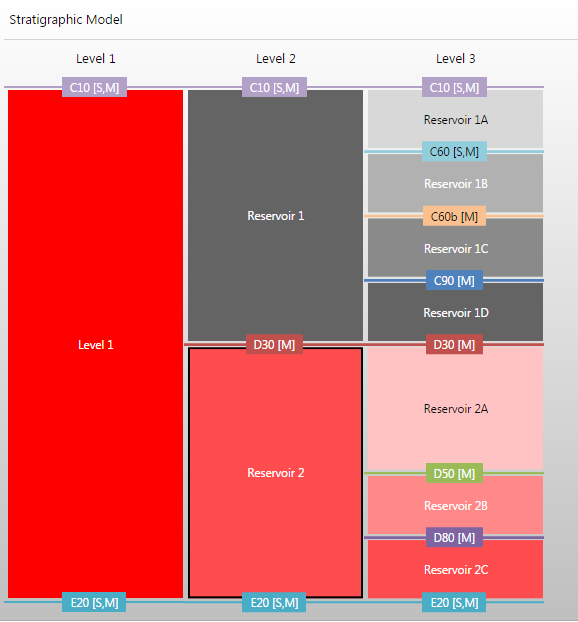
Stratigraphic model that will be used to construct a structural model click to enlarge
Building sequence of unconformities and intrusions assigned to the fault model
Unconformities and intrusions assigned to the fault model are considered discontinuity surfaces and will be constructed first, as they truncate the horizons. This example does not contain any unconformities. For more information, see How to model an unconformity
Building sequence of events with dense data representation (steps A,B,C and D in the table)
-
Geometric priorioity: dense vs sparse
From the geometric representation you can deduce that the first surfaces that are going to be constructed are C10, C60 and E20. These events have a 2D grid representation which is considered dense data. The next step to understand the logic in the order in which these surfaces are constructed is to look at the Stratigraphic Level.
-
Stratigraphic level
First all dense surfaces on Level 1 are constructed, then on Level 2 etc. Event C10 and E20 are present at Level 1. Next, since the User Priority is not set in this example, the Layering Type set for Level 1 will determine the order of construction.
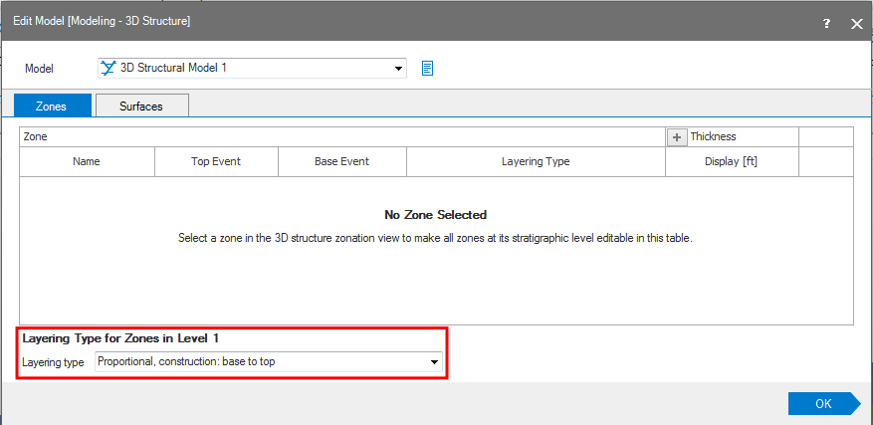
The selected Layering Type will influence the construction sequence of the surfaces click to enlarge
-
Layering Type
The Layering Type for Level 1 is set to Proportional, construction: base to top. This means that first surface E20 will be constructed (step A), second C10 (step B). Once the surfaces from Level 1 are constructed, the surface C60 from Level 3 is constructed, following the same rules (step D).
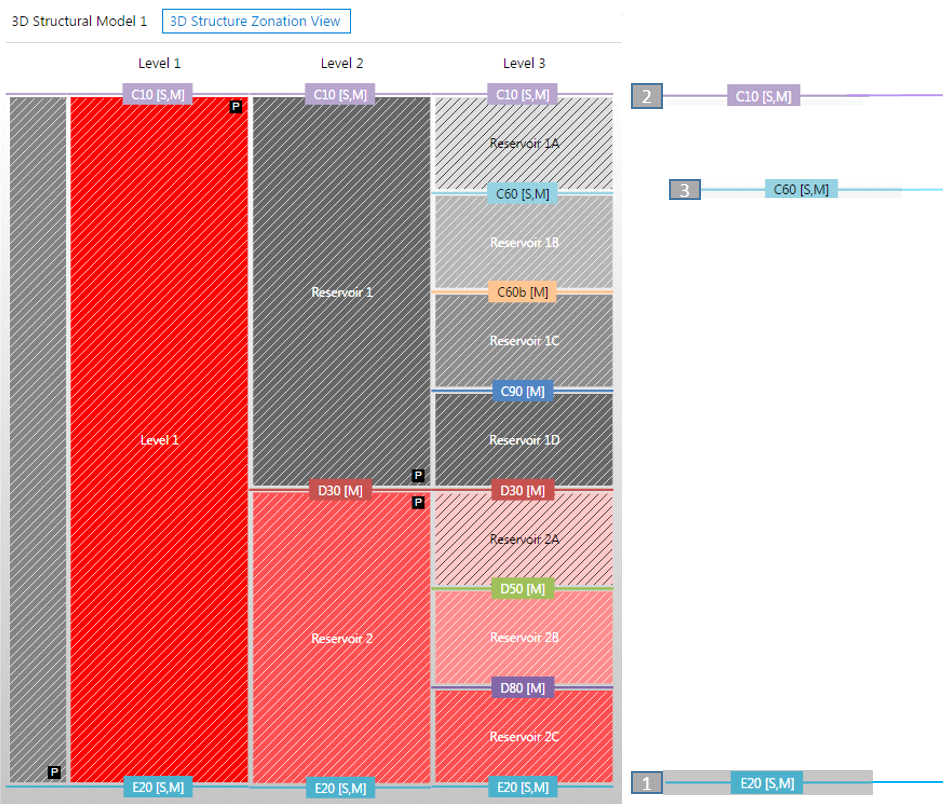
The selected Layering Type, indicated with a small P, will influence the building sequence of the surfaces click to enlarge
In the table below, you can see that building steps A ,B, C and D have been implemented, resulting in a construction sequence for all dense surfaces in the structural model.
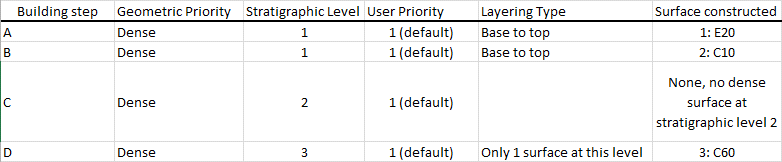
Schematic representation of the building sequence of the surfaces based on the predefined set of rules click to enlarge
Building sequence of events with sparse data representation (steps E through J in the table)
-
Geometric priority: dense vs sparse
All events that have a dense geometric representation are constructed. The events that have a sparse geometric representation will now be constructed.
-
Stratigraphic level
At Level 1 there are no events with sparse data representation (step E). At Level 2, there is only one event, D30. This surface will be constructed next (step F).
-
Layering Type
Next, the events at Level 3 will be constructed based on the Layering Type. For Level 2, the Layering Type is set to Proportional, construction: top to base. The Layering Type for Level 3 is set for Reservoir 1: Proportional, construction: base to top, and Reservoir 2: Proportional, construction: top to base.
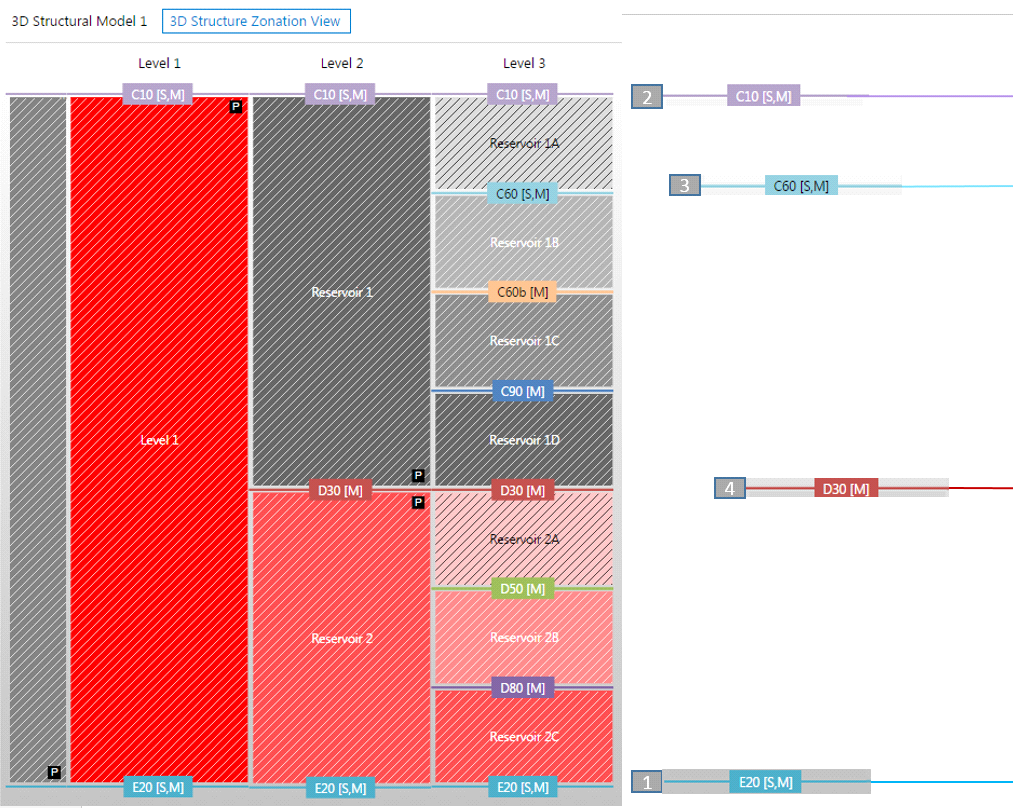
The only event at Level 2 is an event represented by sparse data (marker), which will be constructed fourth. click to enlarge
In the table below, you can see that building steps E and F have been implemented, resulting in the construction of surface D30 in the structural model.
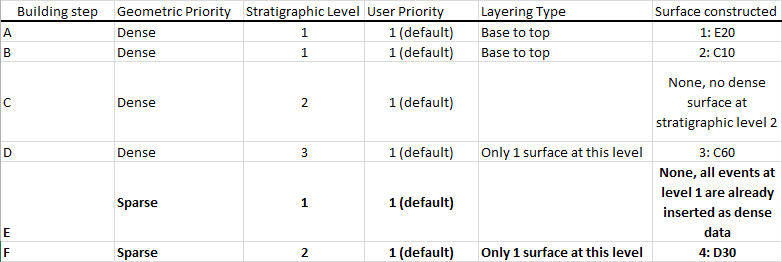
Schematic representation of the building sequence of the surfaces based on the predefined set of rules. click to enlarge
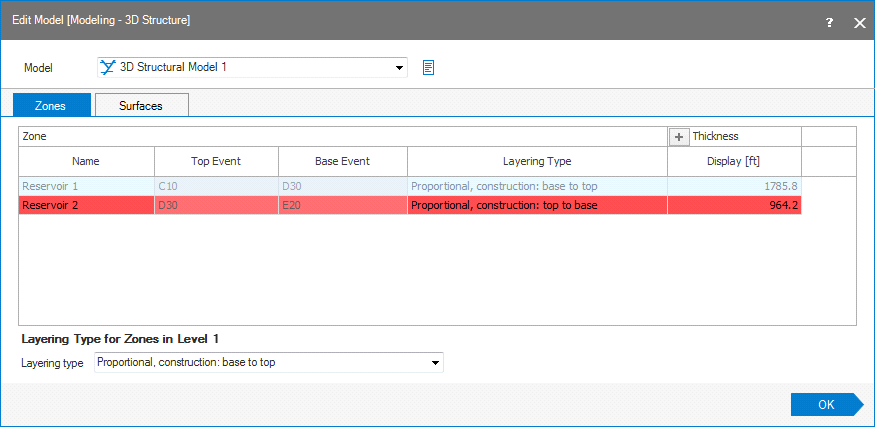
The Layering Type set for Level 3 influences the order of surface construction. click to enlarge
This results in the following order of construction: for Reservoir 1: first C90 and then C60b (step G and H). For Reservoir 2: first D50 and then D80 (step I and J).
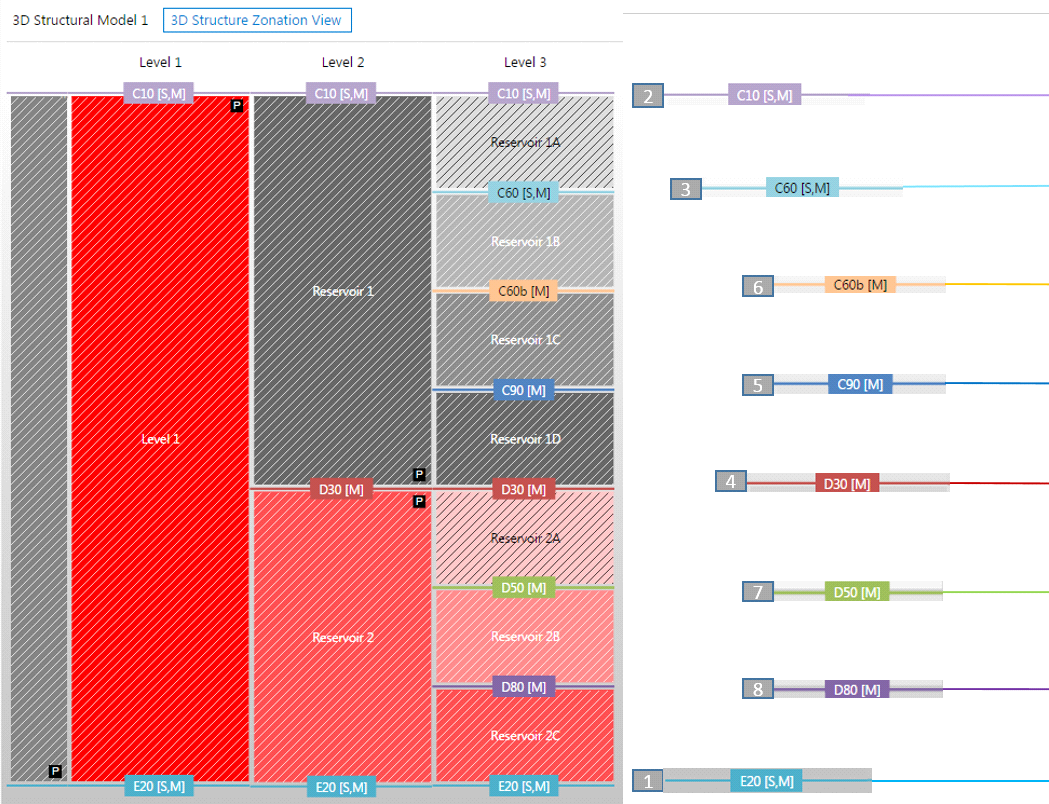
The Layering Type at Level 3 determines the order of construction of the events represented by sparse data at this level. click to enlarge
In the table below, you can see that building steps G,H, I and J have been implemented, resulting in a construction sequence for all sparse data surfaces at Level 3 in the structural model.
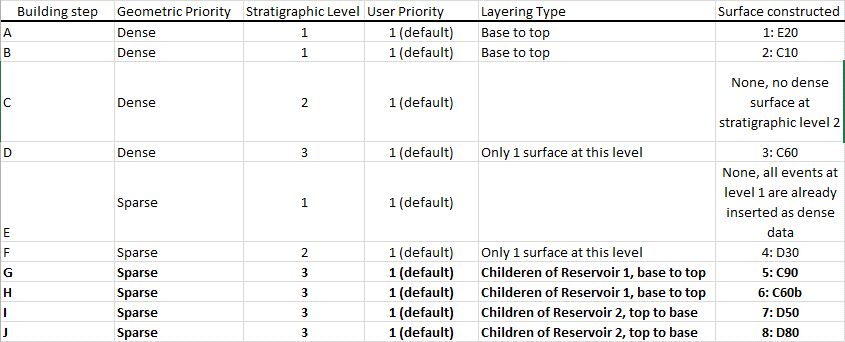
Schematic representation of the building sequence of the surfaces based on the predefined set of rules. click to enlarge